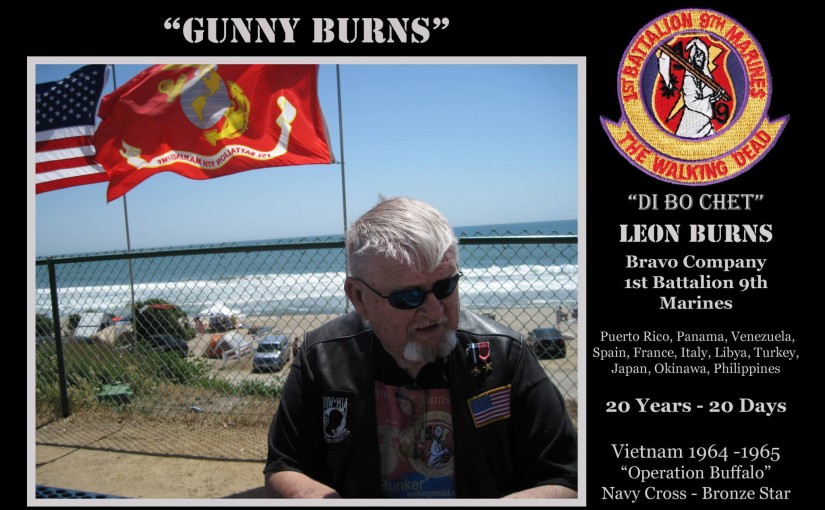
The President of the United States of America takes pleasure in presenting the Navy Cross to Staff Sergeant Leon R. Burns (MCSN: 1487956), United States Marine Corps, for extraordinary heroism in connection with operations against the enemy while serving as a Platoon Commander with Company B, First Battalion, Ninth Marines, THIRD Marine Division (Reinforced), Fleet Marine Force, in the Republic of Vietnam on 2 July 1967. Company B was engaged in…
Source: http://projects.militarytimes.com/citations-medals-awards/recipient.php?recipientid=4052
Leon Burns Memorial Eulogy (Phil Sutherland)
1) Beginning: Read letter and Poem from LtCol George Malone, President 1/9 Network.
2) Read: Navy Cross Certificate
3) Stories: Friendship with Lee
a. I was attached to Bravo 1/9 when we arrived in Vietnam for the 2nd entry into the country at Phu Bai and my 106’s were attached to various units. My gun section went up to Khe Sahn with Bravo Company 1/9, where we were to reinforce the perimeter. During that time, Lee took a patrol out to the area near hills 880 & 881, where his men were engaged by a superior force. It was only through the strategy of relocating his patrol away from where they had initially established their encampment for the night, that his patrol was saved. He argued with the Lieutenant who was leading the patrol who wanted to remain at the location. He informed the Lieutenant that he was moving, because the enemy had spotters that no doubt were observing them setting in and would shell that area. He basically told the Lieutenant that he was moving and that the Lieutenant could stay there, but, he was taking the men with him. Shortly after relocating, the enemy shelled the position where they had been. Later on in the patrol, they were engaged by a large enemy force and Lee managed to bring out most of his patrol despite Withering fire, earning himself a Bronze Star for his actions. This time was known as the Hill Wars, the first battles of Khe Sahn. I heard then about this heroic Gunnery Sergeant that had bravely brought his patrol back in.
b. I heard of him again when my guns were again attached to Bravo Company and assigned to a place called Con Thien. There on July 2nd, Bravo Company went out on Operation Buffalo, where Lee saved many lives at great risk to his own, for which he received the Navy Cross. The story of what happened that day was chronicled in the book entitled Operation Buffalo. He told me with tears in his eyes about how he saved the lives of his men. He was the Platoon Commander of the 4th Platoon of Bravo Company, on a Company Sized Patrol. The company with a new commander marched out into an area called the Trace between two tree lines and were immediately engaged by a superior enemy force. Within a very short time, the first three platoons were heavily engaged and most of the men and officers were killed. He said with his voice wavering that he had to call in Napalm danger close within 50 meters, in order to save the men in his platoon from imminent attack when the rest of the company was overrun by NVA. He said it always bothered him that he didn’t know if any others out there still alive, but, it was his only choice to save those in his platoon from a superior sized enemy force. He managed to save most of those in his platoon by this call. He was able to retreat from his position and ran into a rescue force from Con Thien, accompanied by Tanks who helped pick up many of the men who had been killed. On the way back in, with many of those who had been killed draped over the side of a tank, he came across a UPI reporter who started to take pictures of the men on the tank. He told him “No, that the parents were not going to see their son’s like that!” The photographer started to lift his camera again, saying that he had permission from the General to take photos. As Lee tells it, he had an accidental discharge from his shotgun, firing between the man’s legs, and saying again, no photos. The man wisely relented.
c. I was with him again a 3rd time at Con Thien, in late September and October 1967, until I got wounded in mid-October. By then, he had quite a reputation for getting what nobody else could get. His men always had chow and water. He had gone through Staging as the only all Staff NCO training company, and made friends with Staff NCO’s from all MOS’s. That paid off for him in Vietnam, as he would contact them, and barter and trade for what his men needed. He was tremendously resourceful one time even sending his men through a supply line for another battalion to get new boots and jungle utilities. One story he always liked to tell was when the Battalion Commander wanted Claymores, and couldn’t find any. One of Lee’s men who was using a pond to bath, had found a bunch of Claymores that had been dumped into the pond by the battalion before making a hasty retreat, but they were missing Hell Boxes and wiring. He told the Battalion Commander that he had the Claymores he wanted. The Commander was amazed because nobody could get any Claymores. But, to his dismay, he noted that they were what he called just a bunch of junk with the wiring and hell boxes missing. Lee, being the resourceful man that he was, got some 6 volt batteries and some Lima Lima Com Wire and jury rigged them to fire, and demonstrated that they could be used that way for the Colonel. That was Lee and that story was repeated many times!
d. A few years after the Marines were withdrawn from Vietnam, Lee was the Company Gunny of a company in 1/9, and a young 1st Lieutenant named Mike Hagee was the Company Commander. They were doing a company inspection and when Lt Hagee centered himself on a young private that just arrived he noticed that he was wearing a Navy Cross ribbon. He asked the private where he got the Navy Cross, and the Private told him that saw one on Gunny Burns’ uniform and liked it, so he went to the PX and bought himself one. Years later, Lee and I went to the Change of Command Ceremony for then LtGen Hagee at Camp Pendleton when he was leaving as the Commander of the 1st Marine Expeditionary Force to become Commandant of the Marine Corps. General Hagee in his talk called on Lee to stand and recounted that story. He then said that he told Gunny Burns to square the private away, smacking the palm of his hand with his fist. He said, back then, we could do that. We can’t do that anymore. Following that ceremony, Lee was invited to go to Washington DC for the Change of Command when General Hagee became the 33rd Commandant of the Marine Corps. He was in the reception line when a Major was checking credentials to introduce them to General Hagee. He asked Lee if he knew General Hagee. He responded “Oh yes!” General Hagee heard his voice and immediately turned and said, “Gunny!” and stuck out his hand to greet him.
e. Years after Vietnam, when he had served 16 years in the Marine Corps, the General at 29 Palms California where Lee was in charge of Training was not going to let him re-up for his last four years, telling the Sergeant Major to inform Lee that his appearance of being short and fat did not look like a Marine. Shortly after, the General decided to take the men out for a 26 mile march, and Lee was to go along and be in charge as the training NCOIC. Halfway out, the General, who was wearing a new pair of boots, had bloody socks from blisters on his feet. Lee, being the ever resourceful person that he was, took off the General’s boots, went into his pack and got out some moleskin and some scissors, and treated the General’s bloody feet and gave him a new pair of socks, which he always carried for such occasions. On the way back in, Lee went up and down the line of men, squaring them away and encouraging them to keep going. Just before going into Garrison, he noted how sloppy the men looked, and stopped the formation, went up and down the length telling the men to blouse their boots, tuck in their utilities, and square away their rifles and march with pride like the Marines they were. Shortly after returning to Garrison, and going home to shower, he got a call from the Sergeant Major telling him to report to him. He threw on his uniform and went in. The Sergeant Major then told him that the General had reconsidered and would allow him to ship over for his final tour. The Sergeant Major said that the General, up to that point, had not thought that Lee had what it took to remain a Marine! This was despite the fact that he had a navy cross and bronze star for heroism under fire in combat. This was just because he did not fit the picture postcard image. But, despite his appearance, in his chest beat the heart of a hero, unstoppable, and a true hero, unlike the movies.
f. Lee and I met again in 1994, when they were deactivating 1/9, and we both went to the ceremony at Camp Pendleton where 1/9 was stationed at the time with the 1st Marine Division, with Major General Frank Libutti the Commander of 1st Mar Div. We followed up that meeting with going to the National Reunion of 1/9 Network that fall in San Diego and the rest is history. We lived close to each other in California and started doing things together, from going to groups together at the VA, to going out to dinner and just doing other fun stuff for the next 20 years, going to every Reunion and many other activities with 1/9 Network, sharing rooms together at each event. Lee, besides being my buddy, was also my hero! He was one of the kindest and most caring men I have ever known. He always used to say that he never met the image of a hero, being a short, fat man. True, he never matched the picture postcard image of a Marine, but, he had the heart of a hero. Just like Audie Murphy and others of his ilk, he stepped up when the going got rough. All the MCI courses that he took, and just his caring and resourceful nature, made him one of the finest leaders I have ever known.
When we had our reunion, at the final event, the banquet, we always used to recognize those among us who had received metals. As the President of the 1/9 Association, I always introduced those with the Metal of Honor, then the Navy Cross, and Lee would stand, then Silver Star, etc. and Bronze Star, and again Lee would stand. Finally, I would come to the Purple Heart. I would say that our Battalion was known as the Purple Heart Battalion, and most of us had one. So, instead of having most of the room stand, I wanted those with no Purple Heart to stand. He would always give me one of those looks, as he stood up. People would always be astonished that this man with two metals and especially the Navy Cross never got a Purple Heart. He would always say, “I went from Cover to Concealment!”
g. One final story about Lee: About 13 years ago, when Lee was retired, and I was still working as a Federally Assisted Housing Management Supervisor, I was playing basketball with my son, who was 15 at the time, and ruptured my Achilles tendon. Lee volunteered to drive me around for my job, including to the airport when I had to travel to one of the 5 states I was responsible for. He did that for 6 months while my leg healed. That, was the man I know. He was a very humble man, who would lay down his life for his friend. It says in Scripture, “No greater Love hath any man than this, that he lay down his life for his friends!” He lived that philosophy. He never beat his own drum, but, always lifted up his friends. He called many, many people regularly over the years to check on them and encourage them. Even when his own health was failing, he cared more about others than himself and continued to call.
I loved my friend and will miss him dearly. But, I look forward to the day when we shall be reunited again. I only hope that I can even a little bit, measure up to the example he set for us all.
Semper Fi my old friend and goodbye for now! I know where Lee is, he is faithfully guarding those streets. I can hear him now, “Excuse me God; I have those Claymores you wanted!”